AI Detector vs Plagiarism Checker: What's the Difference?
AI detector vs plagiarism checker: what's the difference? Learn how each tool works, what they detect, and why writers, students, and educators increasingly need both in 2026.


A lot of people use the terms AI detector and plagiarism checker interchangeably.
That's understandable.
After all, both tools are used to evaluate written content. Both generate reports and are commonly used by students, educators, writers, publishers, and businesses.
But an AI detector and a plagiarism checker solve completely different problems.
In 2026, understanding the difference matters more than ever because content can pass a plagiarism check while still being entirely AI-generated.
Let's break down exactly what each tool does and when you should use them.
What Is a Plagiarism Checker?
A plagiarism checker compares your content against a database of existing material.
This database may include:
- Online articles
- Research papers
- Academic journals
- Books
- Previously published content
The goal is simple: Determine whether parts of the text already exist elsewhere.
If matches are found, the plagiarism checker highlights them and provides a similarity score.
For example, during my testing, multiple plagiarism checkers successfully identified passages copied directly from published research papers and traced them back to the original sources.
A plagiarism checker answers one question: "Was this content copied?"
What Is an AI Detector?
An AI detector doesn't search for matching sources.
Instead, it analyzes writing patterns to determine whether a passage was likely written by a human or generated by an AI model.
Many modern platforms assign a score indicating the probability that AI generated the content.
An AI detector answers a different question: "Who wrote this content?"
This distinction is extremely important because AI-generated content can be completely unique while still being machine-written.
Example #1: Winston AI
One of the most interesting tests involved Winston AI
I asked Gemini to rewrite a passage from a research paper.
The result received:
- 0% plagiarism
- An AI-generated classification
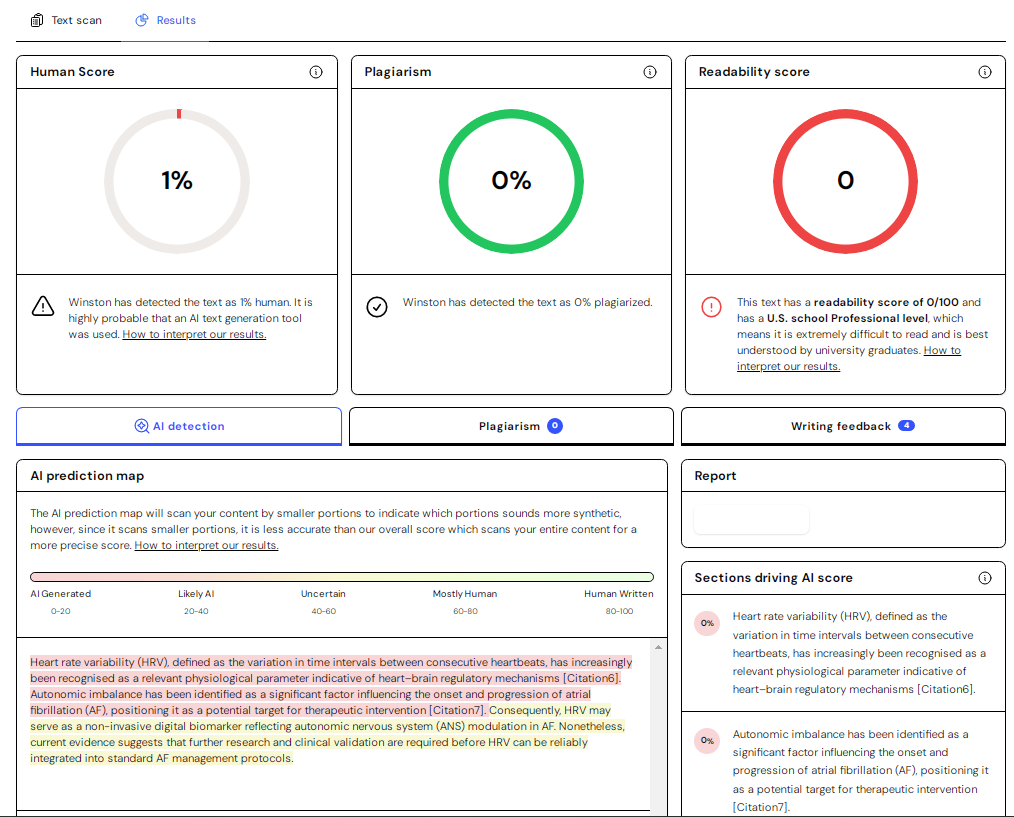
This outcome was technically correct. The rewritten text was unique enough that it wasn't considered plagiarized.
However, Winston AI could still identify that AI had generated the passage.
This goes on to show why plagiarism detection and AI detection serve different purposes.
Example #2: Originality.ai
I tested Originality.ai using a passage generated by ChatGPT.
The plagiarism checker reported 0% plagiarism, but, when I ran the same text through Originality.ai's AI detector, it was flagged as AI-generated.
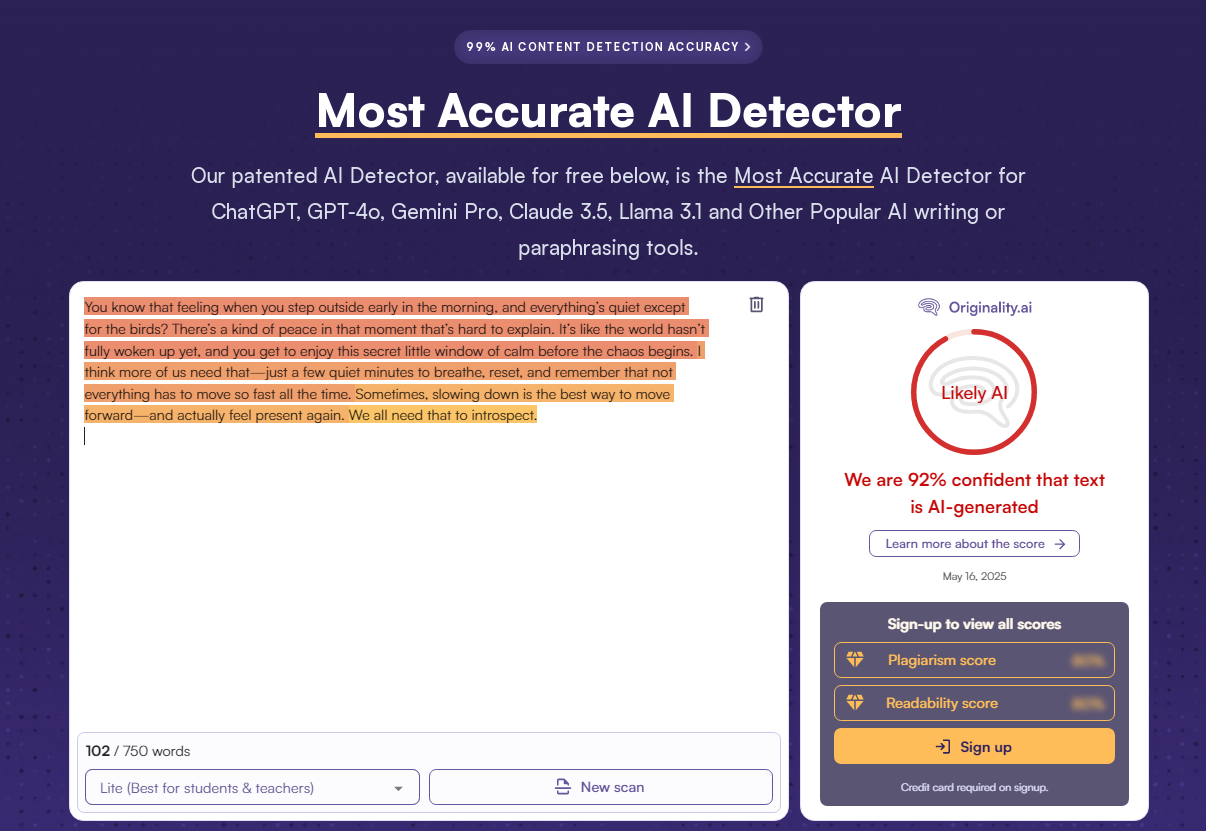
The results show that the content wasn't copied from another source, but it also wasn't written by a human.
Without AI detection, you would only see the plagiarism result and miss an important part of the story.
Example #3: GPTZero
GPTZero provided another useful comparison.
When I tested a passage copied directly from a published research paper, GPTZero identified it as 99% plagiarized.
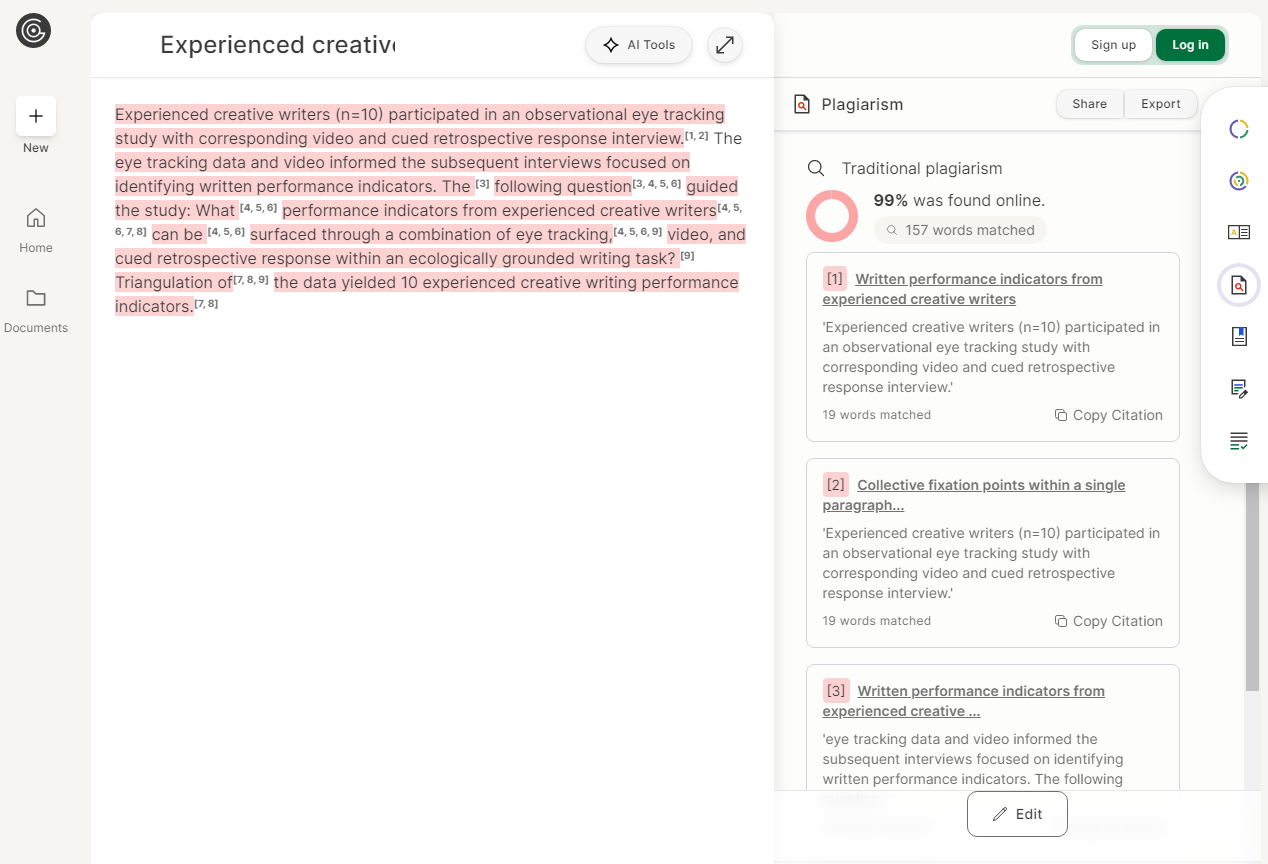
After regenerating the same content using Claude, the rewritten version bypassed plagiarism detection.
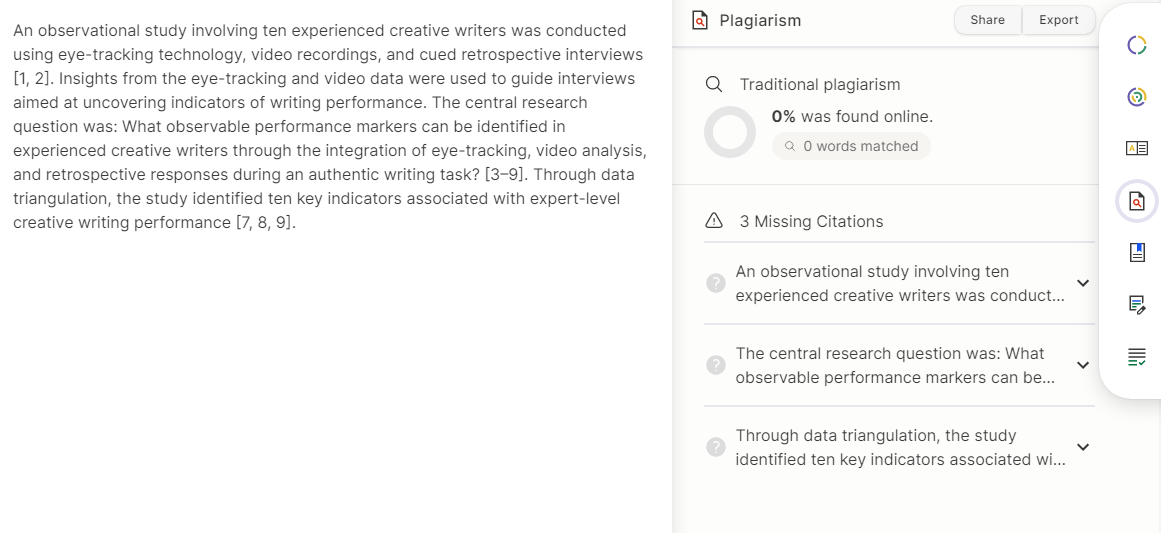
The text no longer matched the original source closely enough to trigger a plagiarism flag.
This doesn't mean the content was necessarily human-written.
It simply means the plagiarism checker couldn't find a direct match.
AI Detector vs Plagiarism Checker: Side-by-Side Comparison
| Feature | AI Detector | Plagiarism Checker |
|---|---|---|
| Detects copied content | No | Yes |
| Detects AI-generated writing | Yes | Usually No |
| Searches online sources | No | Yes |
| Provides similarity scores | No | Yes |
| Identifies source URLs | No | Yes |
| Estimates AI probability | Yes | No |
Can Content Pass One and Fail the Other?
Absolutely.
Here are some common scenarios:
AI-generated but not plagiarized
A language model creates a completely unique passage.
Result:
- 0% plagiarism
- High AI score
Human-written but plagiarized
Someone copies paragraphs from an existing article.
Result:
- High plagiarism score
- Human-written
AI-generated and plagiarized
An AI model rewrites content too closely to the original source.
Result:
- Plagiarism detected
- AI detected
Human-written and original
The ideal outcome.
Result:
- 0% plagiarism
- Human-written
Why Writers Need Both in 2026
The biggest challenge in 2026 is AI-assisted rewriting. Modern AI tools can:
- Rewrite blog posts
- Summarize articles
- Rephrase research papers
- Generate entirely new passages
As a result, plagiarism detection alone no longer tells the full story.
Many of the strongest platforms now combine:
- Plagiarism detection
- AI detection
- Source attribution
- Readability analysis
- Authorship verification
This is one reason tools like Winston AI, Originality.ai, and GPTZero continue to gain popularity.
Which Should You Use?
The answer depends on your goal.
If you want to know whether content was copied, use a plagiarism checker.
If you want to know whether content was generated by AI, use an AI detector.
If you're publishing, grading, editing, or reviewing content in 2026, you'll often need both.
That's because originality and authorship are no longer the same thing.
A piece of content can be completely original while still being generated by AI.
Final Thoughts
AI detectors and plagiarism checkers aren't competitors, rather, complementary tools.
A plagiarism checker tells you whether content matches existing sources.
An AI detector tells you whether the writing appears to come from a language model.
In today's content landscape, relying on only one can leave important blind spots.
The most reliable approach is to use both, especially when evaluating content that may have been assisted or generated by AI.
Affiliate Disclosure: This article contains affiliate links. If you purchase through them, I may earn a small commission at no extra cost to you.