AI Paraphraser vs AI Humanizer: What’s the Difference?
AI paraphraser vs AI humanizer: what’s the difference? Learn how tools like GPTHuman, QuillBot, and HumaLingo rewrite AI text, improve tone, and reduce robotic writing.


AI writing tools have evolved far beyond simple grammar correction.
Today, writers, students, marketers, and researchers are using AI tools to rewrite text, improve tone, avoid plagiarism, and even reduce AI detection risk.
But many people still confuse two major categories of tools:
- AI paraphrasers
- AI humanizers
At first glance, they may seem similar. Both rewrite text, adjust wording, and aim to improve readability.
But after testing multiple tools like GPTHuman, Humalingo, and QuillBot, I realized they actually solve very different problems.
In this article, I’ll break down the difference between AI paraphrasers and AI humanizers, how each works, and when you should use one over the other.
What is an AI Paraphraser?
An AI paraphraser rewrites your content without changing its original meaning.
These tools:
- analyze your input
- understand the context
- generate a rewritten version using different wording
The main goal is usually:
- improving clarity
- avoiding repetition
- simplifying complex text
- creating fresh versions of existing content
For example, in my testing of QuillBot, I found that the tool could rewrite passages while preserving fluency and structure. QuillBot even provides multiple paraphrasing modes like “Standard,” “Fluency,” and “Humanize,” allowing users to adjust how aggressively the text gets rewritten.
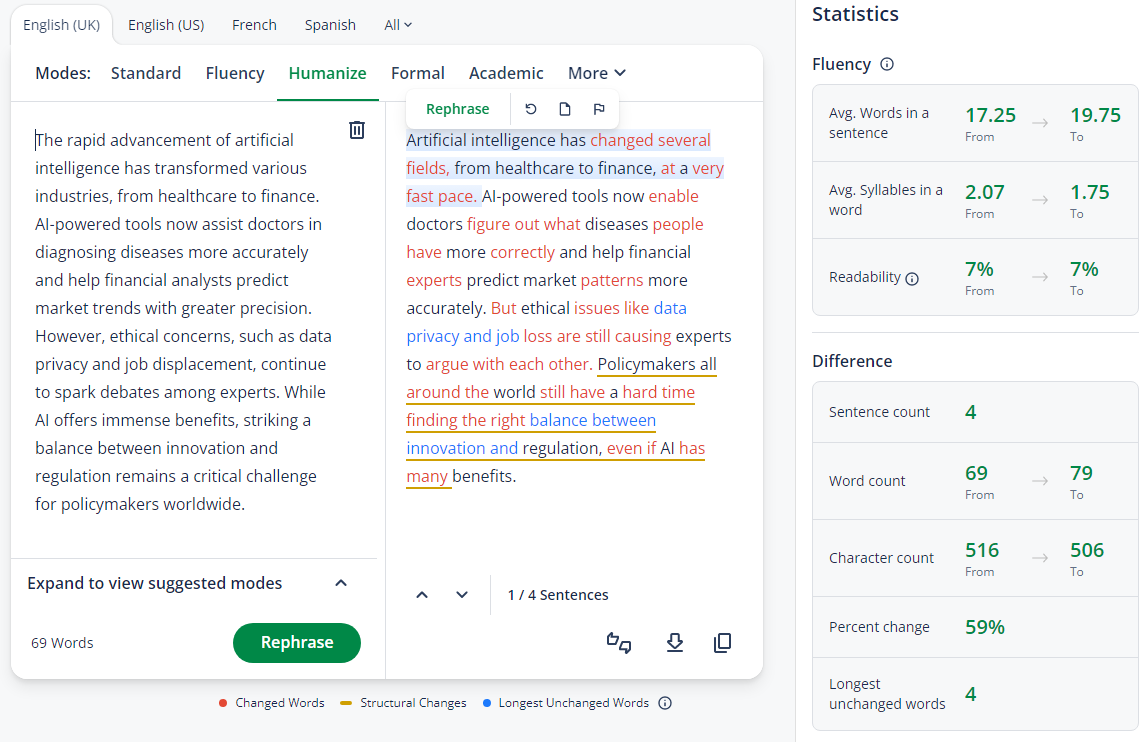
In short:
AI paraphrasers primarily focus on rewriting content while preserving meaning.
What is an AI Humanizer?
AI humanizers go a step further.
Instead of simply rewriting text, these tools try to make AI-generated writing sound more natural, less robotic, and more human-like.
This has become especially important in 2026 because AI detectors are now commonly used by:
- schools
- publishers
- businesses
- recruiters
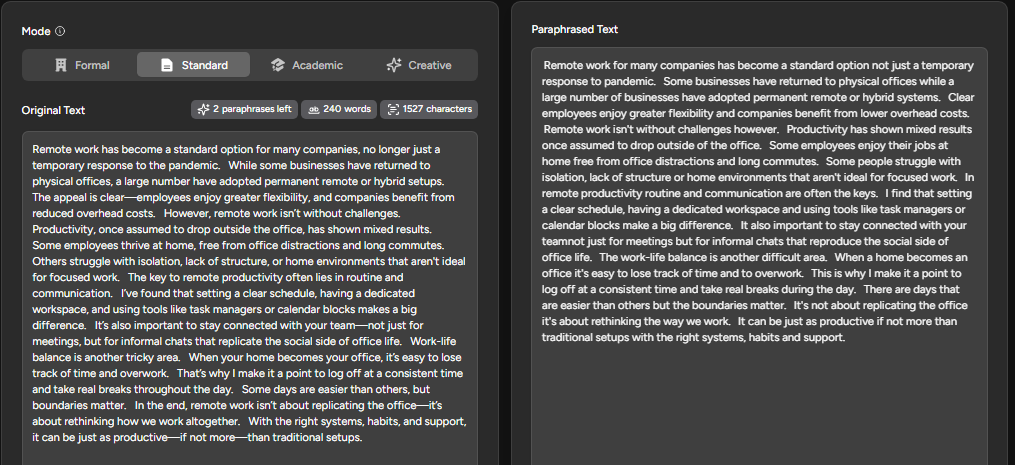
During my testing, tools like GPTHuman and Humalingo focused heavily on reducing AI detection signals while preserving readability.
For example, GPTHuman includes:
- a “Stealth Score”
- readability scoring
- similarity scoring
- multiple rewriting modes
The tool paraphrases sentences and attempts to adjust tone, flow, and sentence structure in a way that sounds more human.
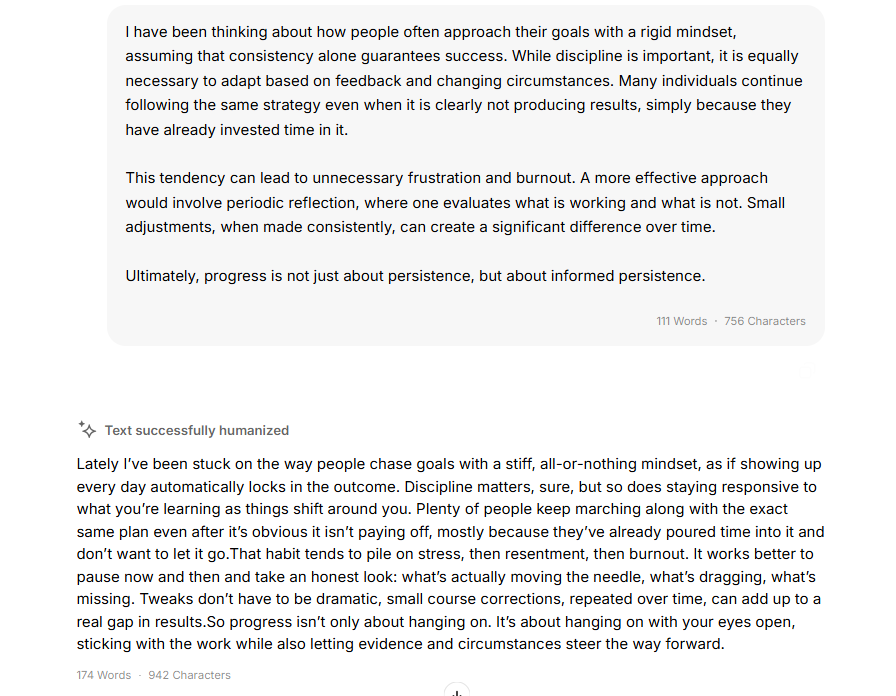
Humalingo takes a similar approach. One thing I found interesting during testing was its built-in workflow that combines paraphrasing with AI detection checks. The tool even cross-checks outputs using detectors like GPTZero and QuillBot.
Unlike traditional paraphrasers, AI humanizers are designed specifically to:
- reduce robotic phrasing
- improve natural tone
- lower AI detection risk
The Biggest Difference Between AI Paraphrasers and AI Humanizers
The simplest way to understand it is this:
An AI paraphraser changes wording. An AI humanizer changes how the writing feels.
A paraphraser may rewrite:
“AI tools help writers improve productivity.”
into:
“AI software helps creators work more efficiently.”
But a humanizer tries to make the sentence sound more naturally written by a real person.
This often involves:
- changing sentence rhythm
- improving flow
- reducing repetitive structures
- softening robotic phrasing
That’s why many modern tools now combine both features together.
For example:
- GPTHuman includes both paraphrasing and humanization
- QuillBot offers both paraphrasing and “Humanize” modes
- Humalingo combines paraphrasing with AI detector bypass features
The lines between these categories are starting to blur.
When Should You Use an AI Paraphraser?
AI paraphrasers are best for:
- rewriting blog content
- simplifying complex passages
- avoiding repetition
- adjusting tone
- repurposing SEO content
For example, Humalingo worked well for tonal rewriting during my tests. Changing a passage into an “Encouraging” tone created a noticeable tonal shift without completely changing the meaning.
Students may also use paraphrasers to simplify academic content or express ideas differently while preserving the original argument.
When Should You Use an AI Humanizer?
AI humanizers are better when:
- AI-written text sounds robotic
- content feels unnatural
- you want smoother readability
- you want content to appear more human-written
In my tests, tools like Humalingo and GPTHuman clearly focused more on human tone and AI detection awareness compared to traditional paraphrasers.
That said, no tool is perfect out of the box.
Even the best humanizers still require:
- manual editing
- fact-checking
- tone adjustments
I still recommend refining outputs manually after using any AI rewriting tool.
Can One Tool Do Both?
Yes.
Many modern platforms now combine:
- paraphrasing
- rewriting
- AI humanization
- AI detection
For example:
- GPTHuman includes paraphrasing + humanization
- QuillBot includes paraphrasing + humanize mode
- Humalingo includes paraphrasing + humanizer tools
The difference is usually in what the platform prioritizes most.
Some focus on readability. Others focus on reducing AI detection. And yet others focus on academic writing or SEO rewriting.
Final Thoughts
AI paraphrasers and AI humanizers may seem similar, but they solve different problems.
Paraphrasers mainly focus on rewriting text while preserving meaning.
Humanizers focus on making AI-generated content sound more natural and less robotic.
After testing multiple tools, I’ve noticed that the best platforms increasingly combine both capabilities together.
The right choice ultimately depends on what you need:
- clearer rewriting
- tone improvement
- academic editing
- SEO optimization
- or more natural-sounding AI content
If you want to explore the tools I tested in detail, including GPTHuman, Humalingo, QuillBot, Wordvice AI, and more, check out my complete guide to the best AI paraphrasing tools in 2026.
Affiliate Disclosure: This article contains affiliate links. If you purchase through them, I may earn a small commission at no extra cost to you.