Can AI-Written Content Be Plagiarized? (2026 Guide)
Can AI-written content be plagiarized? Learn the difference between plagiarism and AI detection, see real examples from Winston AI, Originality.ai, and GPTZero, and understand how originality is evaluated in 2026.


AI writing tools have become incredibly good.
Today, tools like ChatGPT, Gemini, Claude, DeepSeek, and Grok can generate essays, blog posts, research summaries, and marketing copy in seconds.
But this raises an important question: Can AI-written content be plagiarized?
The short answer is: yes, but not always in the way most people think.
Many people assume that if content passes a plagiarism checker, it must be original. In reality, a piece of content can have 0% plagiarism and still be entirely generated by AI.
That's why, in 2026, plagiarism detection and AI detection have become two very different things.
What Is Plagiarism?
Plagiarism occurs when content is copied from another source without proper attribution.
Modern plagiarism checkers compare your text against:
- Online articles
- Research papers
- Academic databases
- Books
- Previously published content
The tool then generates a similarity score showing how much of the text matches existing sources.
A high similarity score doesn't automatically mean wrongdoing, but it does indicate that portions of the content already exist elsewhere.
Is AI-Generated Content Automatically Plagiarism-Free?
Not necessarily.
Most AI tools generate new combinations of words rather than directly copying content from a source.
Because of this, AI-generated text often appears unique when scanned by a plagiarism checker.
However, "unique" and "human-written" are not the same thing.
A plagiarism checker might find no matching sources, while an AI detector could still identify the text as AI-generated.
This is exactly why many modern platforms now include both plagiarism detection and AI detection.
Example #1: Winston AI
During my testing of Winston AI, I asked Gemini to rewrite a passage from a research paper in its own words.
The result was interesting.
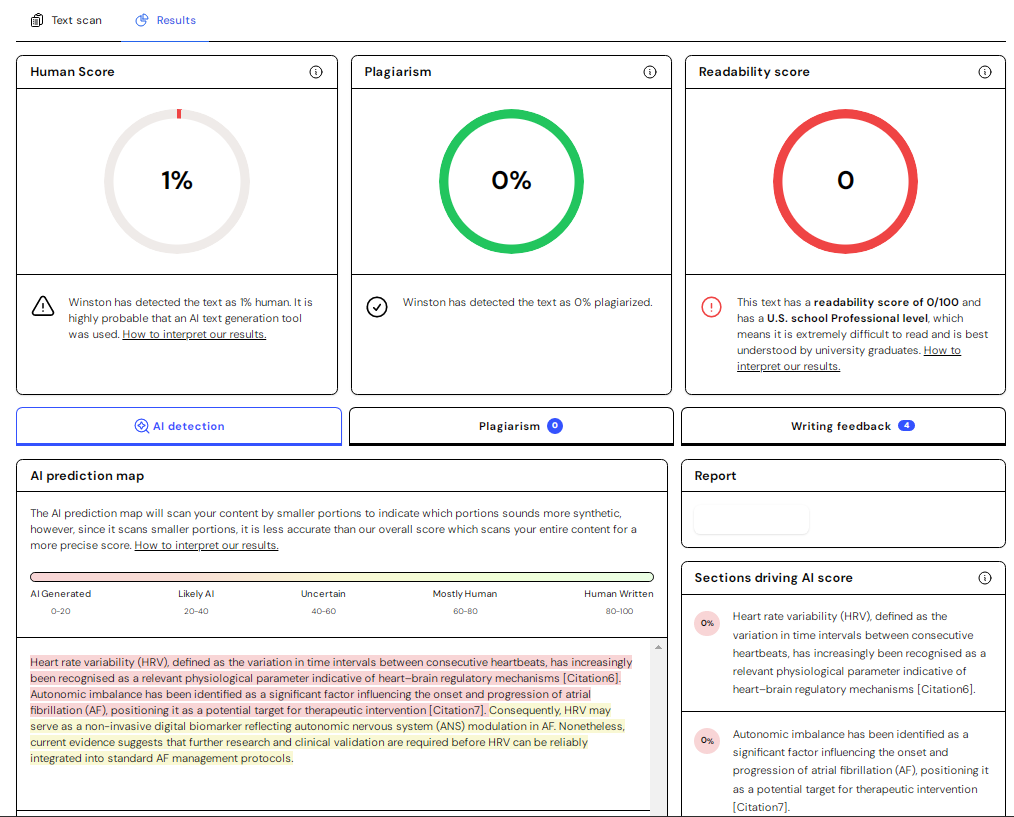
Winston AI reported:
- 0% plagiarism
- The content was still identified as AI-generated
Technically, this result was correct.
The rewritten passage was unique and wasn't copied directly from the original source, so it wasn't plagiarized. However, it had clearly been generated by AI.
This demonstrates why plagiarism detection alone isn't enough in 2026.
Example #2: Originality.ai
I tested Originality.ai using a passage generated by ChatGPT.
The plagiarism checker couldn't find any plagiarism in the text.
However, when I ran the same passage through Originality.ai's AI detector, it was flagged as AI-generated.
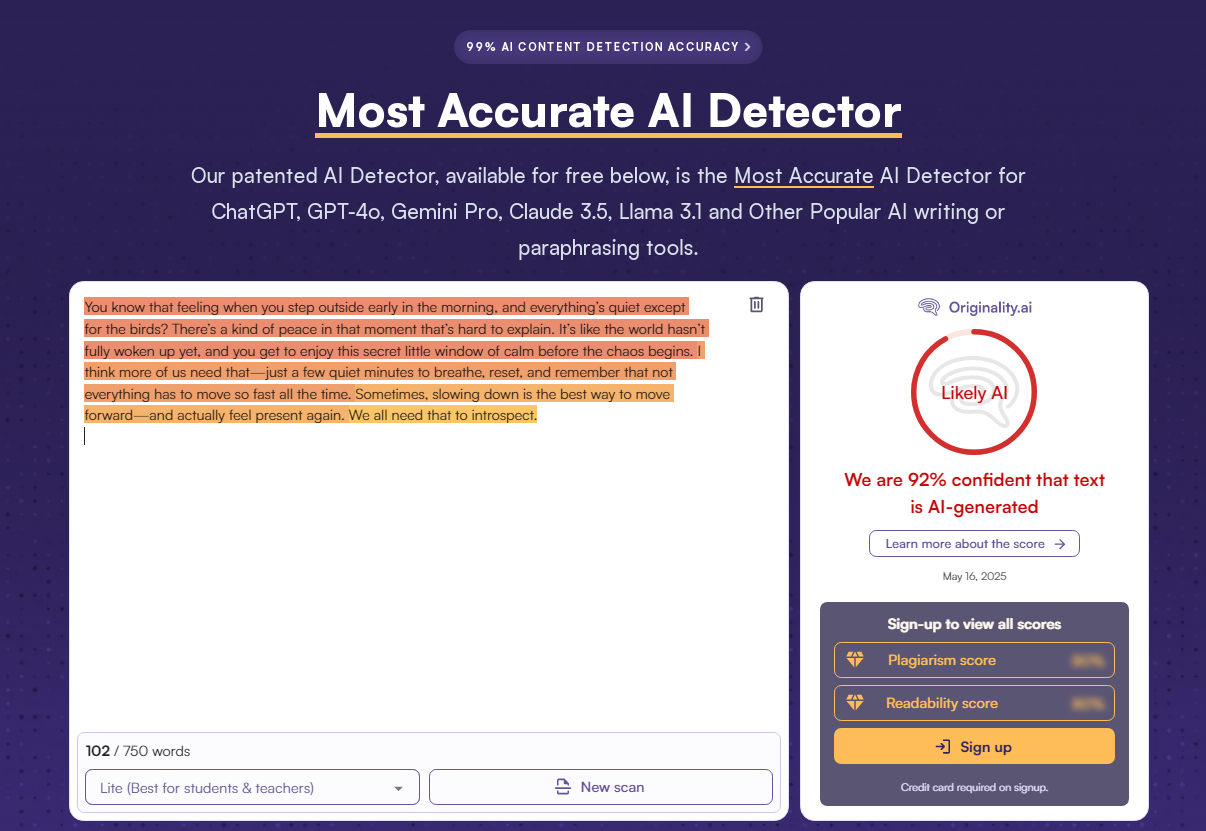
Again, the content was unique, but it wasn't human-written.
This highlights an important distinction:
A plagiarism checker answers "Was this copied?"
An AI detector answers "Who wrote this?"
Those are two completely different questions.
Example #3: GPTZero
GPTZero provided another useful example.
I tested a passage copied from a published research paper.
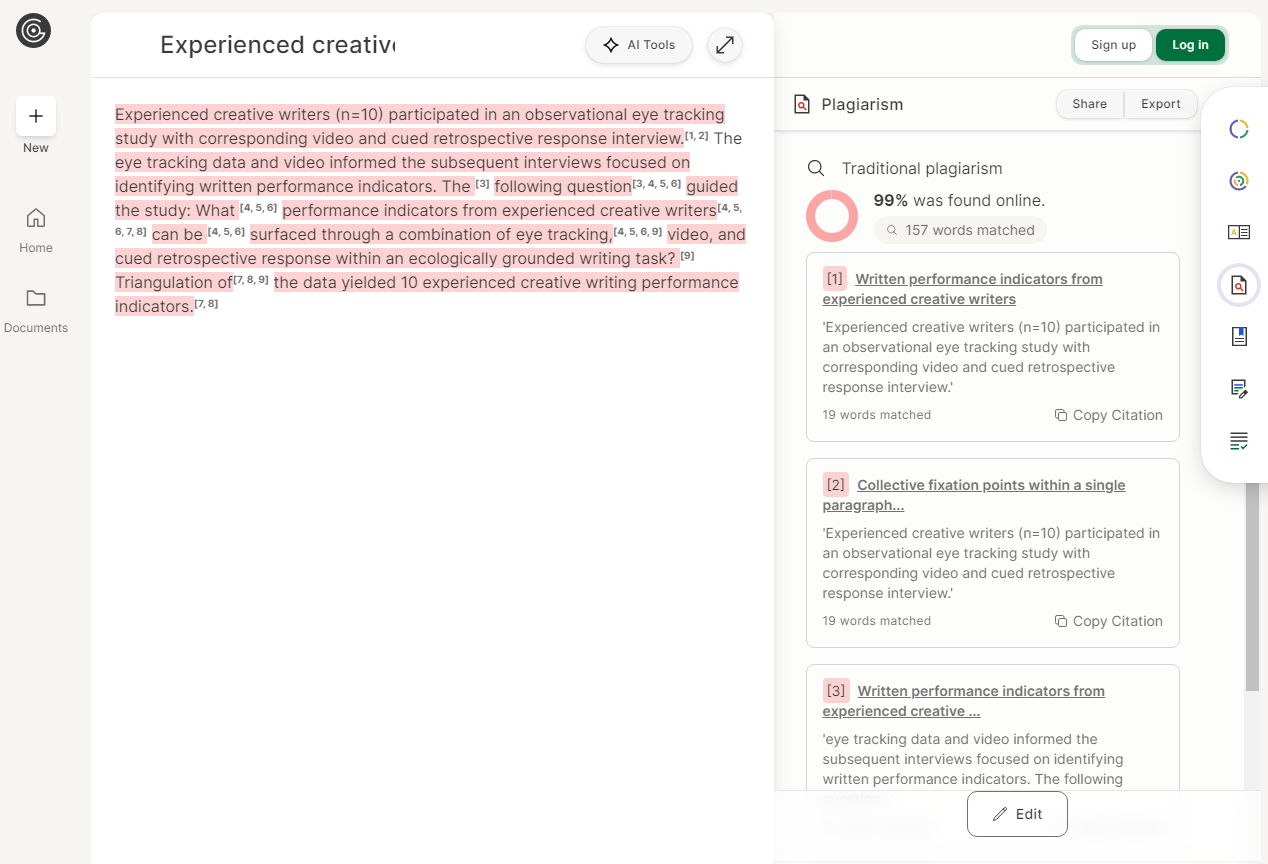
GPTZero detected 99% plagiarism and correctly identified that the content was not original.
When the same passage was regenerated by Claude, however, it bypassed the plagiarism detector.
The rewritten version was unique enough that GPTZero no longer considered it plagiarized.
This doesn't necessarily mean the content was human-written. It simply means the rewritten text no longer matched the original source closely enough to trigger plagiarism detection.
Why AI Detection and Plagiarism Detection Are Different
Many people use these terms interchangeably, but they solve different problems.
| Plagiarism Checker | AI Detector |
|---|---|
| Finds copied content | Identifies AI-generated content |
| Compares against online sources | Analyzes writing patterns |
| Produces similarity scores | Produces AI probability scores |
| Shows matching sources | Estimates whether AI wrote the text |
A piece of content can be:
- Human-written and plagiarized
- Human-written and original
- AI-generated and original
- AI-generated and plagiarized
This is why relying on only one type of scanner can leave gaps.
What Changed in 2026?
The biggest challenge today is no longer direct copy-pasting.
It's AI-assisted rewriting.
Modern AI tools can:
- Rewrite blog posts
- Paraphrase research papers
- Summarize articles
- Generate entirely new passages
As a result, plagiarism checkers alone are no longer enough for many workflows.
The most useful platforms now combine:
- Plagiarism detection
- AI detection
- Source attribution
- Readability analysis
- Authorship verification
This is one reason tools like Winston AI, GPTZero, and Originality.ai have become increasingly popular.
So, Can AI-Written Content Be Plagiarized?
Yes.
If AI-generated content copies or closely reproduces existing material, it can absolutely be considered plagiarized.
However, AI-generated content can also be completely unique and receive a 0% plagiarism score.
That's why passing a plagiarism checker doesn't automatically prove that content was written by a human.
In 2026, the safest approach is to use tools that check for both plagiarism and AI-generated text.
If your goal is to publish original content, you need to know two things:
- Was this copied from somewhere else?
- Was this written by a human or AI?
Those are separate questions, and they require separate checks.
Final Thoughts
AI has changed the way we think about originality.
A few years ago, plagiarism detection was enough for most writers, students, and educators. Today, AI-generated content can easily pass plagiarism checks while still being entirely machine-written.
That's why modern workflows increasingly combine plagiarism detection with AI detection.
If you're evaluating content in 2026, don't stop at asking whether it's plagiarized.
Ask who wrote it.
Affiliate Disclosure: This article contains affiliate links. If you purchase through them, I may earn a small commission at no extra cost to you.