Can AI Paraphrasing Tools Bypass AI Detectors?
Can AI paraphrasing tools bypass AI detectors? I tested tools like GPTHuman, HumaLingo, QuillBot, and Undetectable AI to see how detection-aware rewriting actually performs in 2026.


AI paraphrasing tools have exploded in popularity over the last few years.
Students use them to rewrite essays, marketers use them to repurpose content, while writers use them to improve readability and tone.
But in 2026, one question keeps coming up again and again: Can AI paraphrasing tools actually bypass AI detectors?
After testing multiple paraphrasing tools including GPTHuman, Humalingo, QuillBot, and Undetectable AI, the answer is more complicated than a simple yes or no.
Some tools clearly perform better than others. Some outputs still sound robotic. And some tools are now specifically optimized for AI detection resistance.
Here’s what I learned during testing.
Why AI Detectors Flag Content in the First Place
AI detectors don’t actually “understand” writing the way humans do.
Instead, they look for patterns commonly found in AI-generated text, such as:
- repetitive sentence structures
- predictable phrasing
- overly polished flow
- unnatural consistency
This is why even well-written AI content can sometimes get flagged.
Many AI-generated passages sound technically correct but lack natural variation in tone, rhythm, and sentence structure.
That’s also why paraphrasing alone does not automatically make content undetectable.
What AI Paraphrasing Tools Actually Do
A paraphraser rewrites content without changing its original meaning.
Most tools:
- replace wording
- restructure sentences
- adjust tone
- improve readability
For example, during my tests of QuillBot, the tool provided multiple rewriting modes like:
- Standard
- Fluency
- Humanize
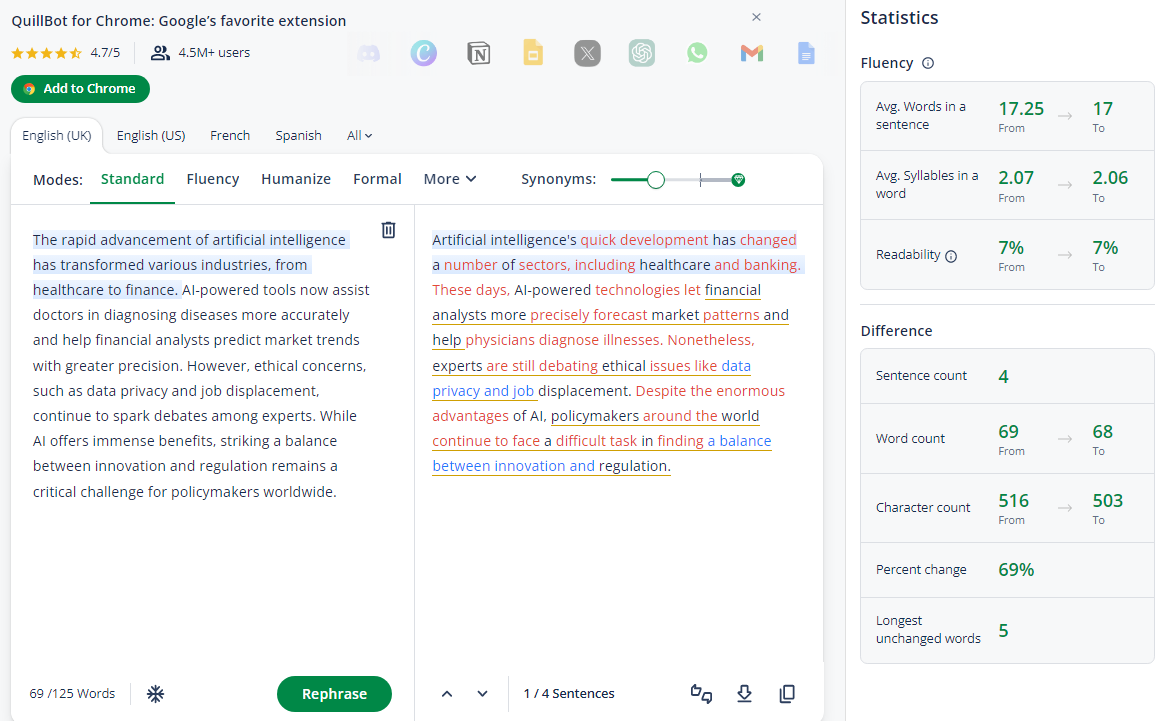
These tools are excellent for:
- reducing repetition
- simplifying text
- rewriting passages
- repurposing SEO content
But traditional paraphrasing alone doesn’t always remove the patterns AI detectors look for.
Why Some Paraphrasers Perform Better Against AI Detectors
Some newer tools are now built specifically with AI detection awareness in mind.
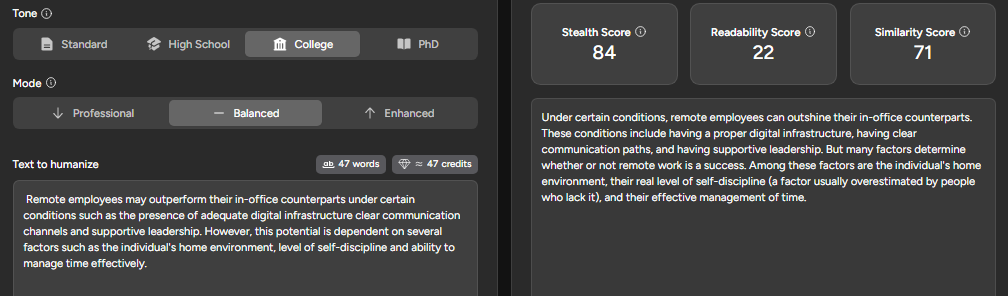
For example, GPTHuman doesn’t just paraphrase content. The platform also includes:
- AI humanization
- stealth scoring
- readability scoring
- similarity scoring
During testing, GPTHuman focused heavily on making passages sound more natural instead of simply replacing words with synonyms.
Humalingo takes a similar approach.
What stood out to me during testing was its built-in workflow that combines paraphrasing with AI detection checks.
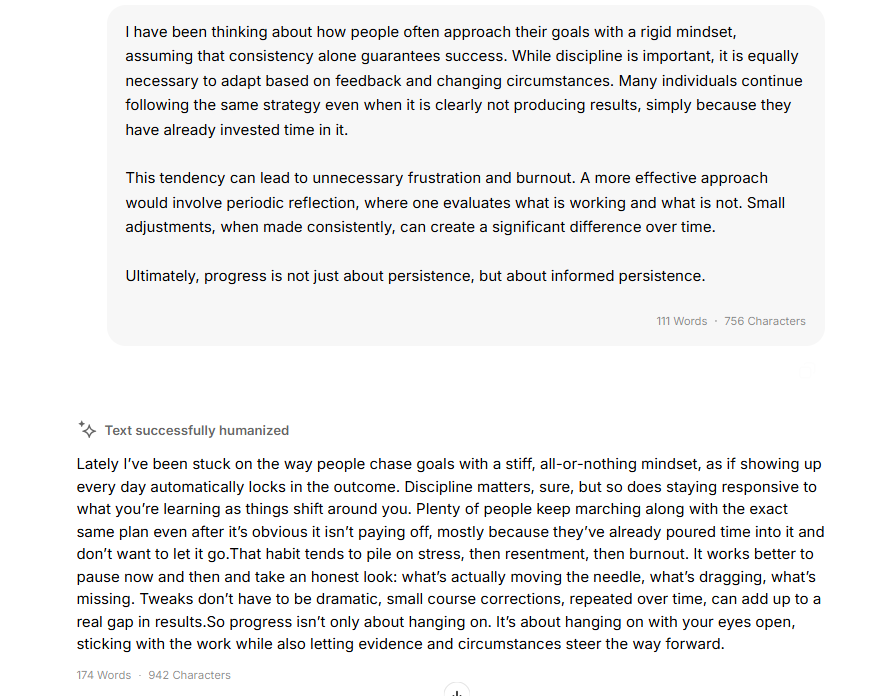
In one of my tests, a ChatGPT-generated passage originally showed a 100% AI-generated score in QuillBot’s detector. After rewriting the passage using Humalingo, the rewritten output showed a significantly lower AI detection result.
This highlights an important distinction:
Some modern paraphrasing tools are actually functioning more like AI humanizers.
Can Paraphrasing Alone Bypass AI Detection?
Not reliably.
Simply replacing words or restructuring sentences is often not enough.
If the rewritten passage still sounds overly polished, uses repetitive structure, and lacks natural variation, many AI detectors may still flag it.
This is something I noticed while testing multiple tools. Even the best tools are not perfect out of the box.
The Most Effective Approach
The strongest results usually came from combining:
- paraphrasing
- humanization
- manual editing
During testing, tools like GPTHuman and Humalingo performed better because they focused not just on rewriting text, but also on improving natural tone and flow.
Manual editing still matters.
I always recommend:
- checking facts
- adjusting awkward phrasing
- improving sentence rhythm
- adding natural variation
AI tools can help significantly, but human refinement still plays a major role in making content sound authentic.
Are AI Detectors Always Accurate?
No.
AI detectors are still imperfect.
Even human-written content can sometimes get flagged because detectors rely on probability and writing patterns rather than true understanding.
That’s why many writers now focus less on “tricking” detectors and more on creating genuinely natural, readable content.
The best AI paraphrasing tools help improve readability and flow. The best AI humanizers go a step further by reducing robotic phrasing.
But no tool can guarantee perfect results every single time.
Final Verdict
Can AI paraphrasing tools bypass AI detectors?
Sometimes, but it depends heavily on the tool and how you use it.
Traditional paraphrasers mainly rewrite wording. Detection-aware tools focus more on human tone and natural flow.
After testing multiple platforms, I found that tools like GPTHuman and Humalingo performed better because they combined paraphrasing with AI humanization workflows.
That said:
- no paraphraser is perfect
- manual editing still matters
- natural writing is still the most important factor
If you want to see the full breakdown of the tools I tested, including GPTHuman, HumaLingo, QuillBot, Wordvice AI, Undetectable AI, and more, check out my complete guide to the best AI paraphrasing tools in 2026.
Affiliate Disclosure: This article contains affiliate links. If you purchase through them, I may earn a small commission at no extra cost to you.